(215) 607-8804Crews on the road 6 AM to 6 PM, Monday to Saturday. Phones answered 24/7 — outside crew hours an automated assistant takes your details and books your free on-site estimate.
PA Contractor #PA112494 · 10+ years · 1,000+ jobs
Based at 127 S 5th St, Quakertown, PA 18951
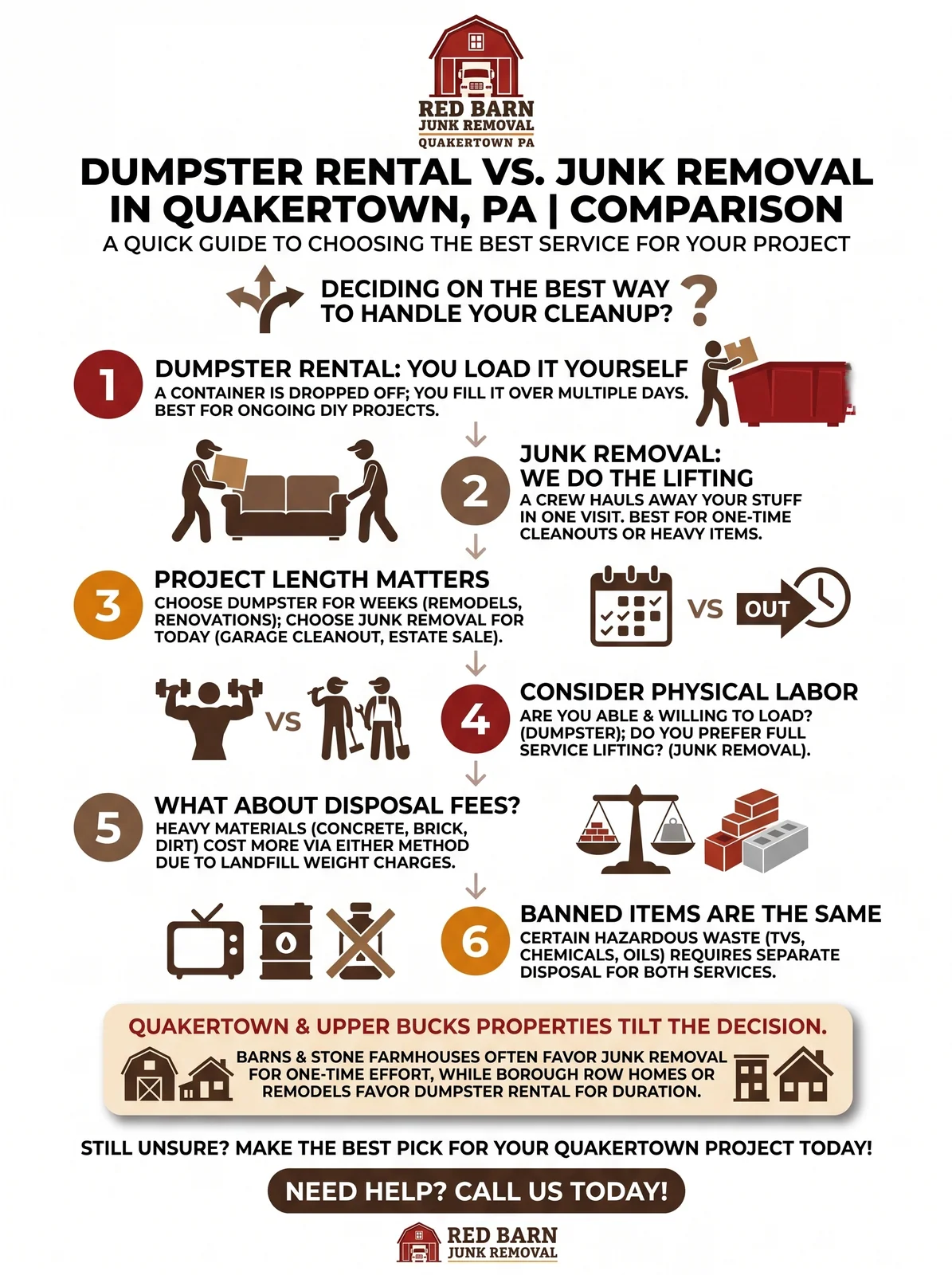
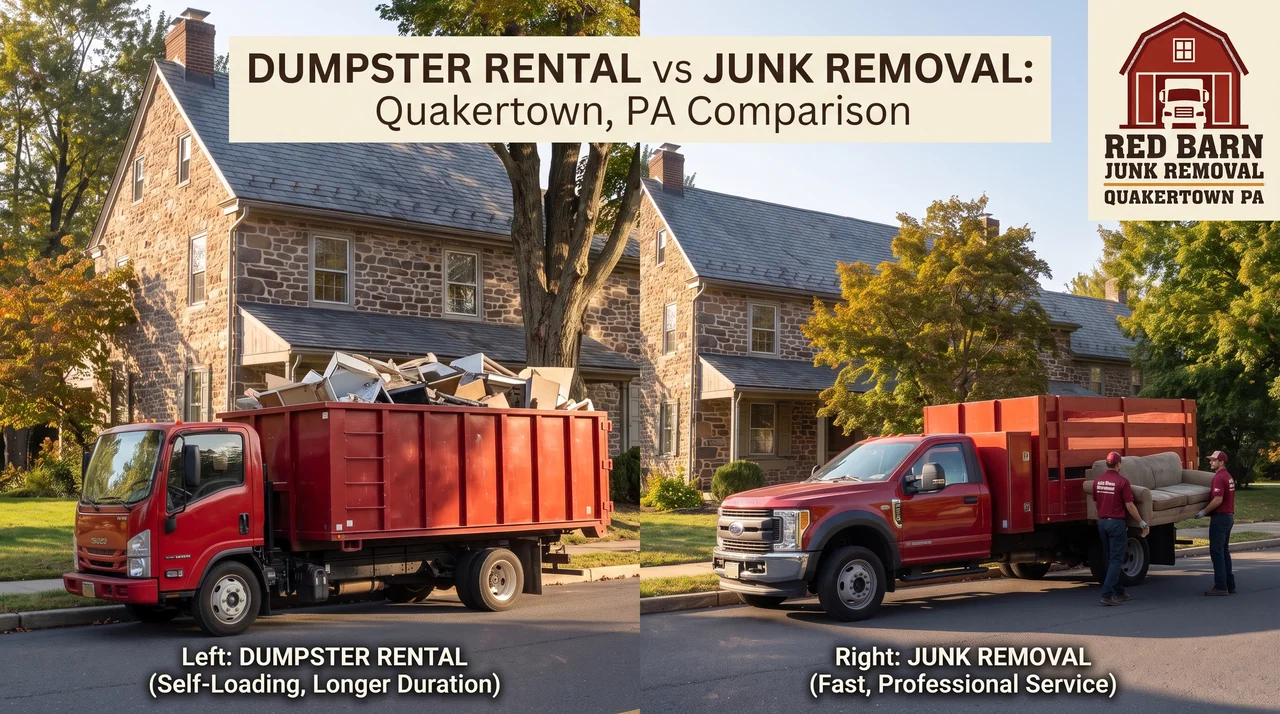
Dumpster rental means a container sits on your property and you load it yourself over several days — usually the cheaper route for a spread-out DIY project. Junk removal means a crew shows up, does the lifting, and hauls everything away in one visit — better for a one-time cleanout or anything heavy and awkward. The right pick depends on how long your project runs, whether you can do the labor, and what you’re actually getting rid of.
What You Need to Know Before You Book Either One
Dumpster rental works best for multi-day renovation or cleanup projects where debris builds up gradually.
Junk removal works best when you want it gone today, in one visit, without lifting a finger.
Heavy material like concrete, brick, and dirt costs more with either method — landfills charge by weight.
Both methods share the same list of banned items: TVs, chemicals, oils, and hazardous waste need separate disposal.
Quakertown and Upper Bucks properties — barns, stone farmhouses, borough row homes — often tilt the decision toward one method or the other.
The Short Answer: When Each One Makes Sense
If you already know your project type, this section alone might settle it. Everything below expands on the reasoning.
Choose a dumpster rental if…
Your project runs multiple days or weeks — a kitchen remodel, a full basement renovation, a long yard-clearing project.
You’re able to physically load the container yourself, on your own schedule.
Debris builds up steadily rather than all at once, like a DIY demolition or a room-by-room gut job.
You have driveway or street space to spare for the length of the rental.
Choose junk removal if…
It’s a one-time cleanout — a garage, basement, attic, or an entire property that needs to be emptied in a single visit.
You don’t want to, or physically can’t, carry heavy items yourself.
You’re dealing with awkward or heavy material: a piano, an old oil tank, appliances, concrete, or furniture down narrow stairs.
You need the space clear today or tomorrow, with nothing left sitting in your driveway.
In Upper Bucks, this plays out constantly with barn cleanouts, basement and garage clear-outs, and estate cleanouts — jobs where the volume is unpredictable and the access is often tight.
How Dumpster Rental Works
A roll-off container gets dropped at your property, usually in the driveway or on the street with a permit if required. You load it yourself, at your own pace, over the rental period — typically several days to a couple of weeks depending on the provider. Once you’re done, or the rental period ends, the company picks it up.
Containers come in a range of sizes, measured in cubic yards, and pricing is usually a flat rate that includes a weight allowance. Go over that weight and you pay an overage fee — which matters a lot if your debris includes concrete, dirt, or shingles. Placement matters too: a driveway avoids permit headaches, while a street placement may require a permit from the borough or township.
Pros and Cons of a Dumpster Rental
Pro: Cost-effective for long projects with steady debris output.
Pro: You load on your own schedule, no need to coordinate a crew visit.
Pro: Good fit for renovation debris that accumulates over days or weeks.
Con: You do all the physical labor — carrying, lifting, loading.
Con: The container occupies driveway or street space for the full rental period.
Con: Weight limits and overage charges apply, especially with heavy debris [verify exact limits with provider].
Con: Certain materials are prohibited outright, and you’re responsible for what goes in.
How Junk Removal Works
You point at what needs to go, and a crew carries it out — from the loft, the cellar, the garage, or the back field — loads it onto the truck, and hauls it away, often in a single visit. Pricing is typically volume-based: you pay for the amount of truck space your items fill, not a flat container fee.
Estimates can be given from photos or on site, and same-day or next-day service is often available when scheduling and dump access line up. A good crew handles the parts a dumpster can’t: narrow cellar stairs, tight doorways, second-floor furniture, and material too heavy to carry to a curb yourself. A firm price is agreed at the property before anything is loaded, so there’s no guessing after the fact. This is where trash removal Quakertown services differ most clearly from a self-serve container.
Pros and Cons of Junk Removal
Pro: No lifting or hauling on your part — the crew does it all.
Pro: Usually done in a single visit, sometimes across a few truckloads for larger properties.
Pro: Handles heavy or awkward items a dumpster can’t accept without extra fees.
Pro: Nothing sits on your property for days — no container to work around.
Con: Per-item cost can run higher than a dumpster for very large, easily self-loaded volumes.
Con: Less useful if you want to fill a container gradually over several weeks.
Side-by-Side Comparison
Factor
Dumpster Rental
Junk Removal
Who loads it
You
The crew
Timeline
Multi-day rental period
Usually a single visit
Pricing model
Flat rate + weight allowance, overage fees beyond that
Priced by truck space filled, plus published surcharges
Space required
Container sits on your property for days
None — nothing left behind
Best-fit projects
Renovations, ongoing DIY debris
One-time cleanouts, estate or property clear-outs
Heavy material
Allowed but often triggers weight overage fees
Often surcharged; some companies refuse it outright
Labor included
No
Yes
Cost Comparison: What Drives the Price
Neither method has one universal price, but the cost logic is straightforward once you see how each is built.
A dumpster rental is priced as a flat fee tied to container size and rental length, with a weight allowance baked in. Go over that allowance and you pay per ton — which adds up fast with concrete, dirt, shingles, or anything dense. For a small pile, the flat minimum can end up costing more than a smaller, partial junk-removal load would.
Junk removal is priced by the truck space your items take up — from a small fraction of a load up to a full or extra-large truck. Heavy material like concrete, brick, or dirt typically adds a published surcharge on top, because the landfill charges by weight, not by volume. Distance from the hauler’s base can also add a travel fee. For a large, multi-day DIY project with steady debris, a dumpster is often the cheaper route; for a single big pile or heavy items you can’t move yourself, junk removal frequently costs less than people expect. Any specific dollar figure here should be confirmed directly with the provider [verify].
Heavy Materials: Concrete, Dirt, Oil Tanks and More
Both dumpster rentals and junk-removal companies put limits on heavy or hazardous material — and this is where Upper Bucks properties run into trouble more than most. Barns, oil-heated farmhouses, and older stone homes routinely produce concrete, brick, dirt, scrap metal, and heating-oil tanks — items many junk-removal companies flatly refuse.
With a dumpster, heavy material usually means hitting the weight allowance fast and paying overage fees on top of the rental cost. With junk removal, it typically means a stated heavy-material surcharge, applied per load. Either way, weight — not just size — is what drives the extra cost.
Neither method takes everything. Asbestos, motor and cooking oil, chemicals, pesticides, propane, and medical waste are excluded from both a rented container and a standard haul-away crew. Items in that category need to go to a Bucks County household hazardous waste collection event instead.
What You Can and Can’t Put in Either One
Pennsylvania law adds a wrinkle that surprises a lot of homeowners. Since 2013, trash haulers in PA have been legally barred from accepting “covered devices” — TVs, computers, and monitors — under the Covered Device Recycling Act (Act 108 of 2010). That means these items can’t legally go into a standard dumpster or curbside pickup; they need certified electronics recycling instead.
Freon-containing appliances — refrigerators, freezers, some AC units — require professional refrigerant handling before disposal, which neither a dumpster nor an untrained hauler can legally skip. Quakertown Borough also publishes its own list of unacceptable items for regular trash collection, which is worth checking before you assume something can just go curbside.
Not accepted in a standard dumpster or by most haulers: asbestos, paint, solvents, pesticides, propane, medical waste.
Requires professional handling: Freon appliances, heating-oil tanks.
Best routed to a Bucks County HHW event: chemicals, motor oil, cooking oil, and other liquid waste.
Choosing for Common Quakertown Projects
Applying the comparison to real Upper Bucks scenarios makes the decision easier than reading pros and cons in the abstract.
A garage or basement cleanout
If it’s mostly boxes, old furniture, and general clutter you can carry yourself, a dumpster can work fine. If the basement has narrow stairs typical of an older Quakertown home, or the garage holds an old washer and a couch you’d rather not carry, a crew handling furniture removal service and appliance haul-away in one visit is usually less hassle.
A multi-week home renovation
This is the clearest case for a dumpster. Debris builds up over days as work progresses, and having a container on-site means you’re not scheduling a truck every time a room gets gutted.
An estate or whole-property cleanout
These jobs move fast, involve unpredictable volume, and often need to close out on a tight timeline for a sale or settlement. A crew that can quote and clear a property across multiple truckloads in a day or two — the kind of work covered under estate cleanout services — generally beats trying to fill and refill a dumpster yourself.
A barn or outbuilding clear-out
Bank barns with ladder-only lofts, corn cribs, and equipment sheds hold decades of scrap metal, old machinery, and tires — heavy, awkward material that’s genuinely hard to self-load into a dumpster. This is squarely junk-removal territory, provided the company actually takes heavy material rather than refusing it at the driveway.
A single heavy item — piano, oil tank, or similar
One heavy item rarely justifies renting a container at all. A single-item pickup from a junk-removal crew is almost always the simpler and cheaper path here.
Yard overgrowth or storm debris
Brush, branches, and general yard debris can go either way depending on volume — a dumpster if it’s an ongoing property cleanup, or a quick yard waste removal visit if it’s a one-time clear-out.
Permits, Placement and Timing Considerations
Dumpster placement on a driveway usually avoids paperwork, but placing one on a public street often requires a permit from the borough or township — worth checking before the container arrives. HOA rules, if applicable, may also restrict where or how long a container can sit. Weekend and holiday pickups can slip, since not every hauler runs a full schedule on Saturdays or Sundays.
Junk removal has its own timing constraint: transfer stations aren’t open every day, and many are closed on weekends and holidays. A same-day promise only holds up when a dump run is actually possible that day — something worth confirming when you book rather than assuming.
How to Decide: A Simple Checklist
Run through these questions before committing to either method:
Can I physically do the loading myself, or would I rather not?
How long will the project realistically take — one day, or several weeks?
Do I have driveway or street space to spare for a container?
Is any of the material heavy, hazardous, or restricted — concrete, an oil tank, chemicals?
Do I need this gone today, or am I fine working through it gradually?
If you’re still weighing your options, it helps to see how other homeowners approach choosing a junk removal company in the first place — pricing transparency and what they will and won’t take matter as much as speed.
For a one-visit cleanout, a heavy item, or anything a dumpster can’t easily handle in Quakertown and Upper Bucks County, Red Barn Junk Removal of Quakertown offers a free on-site or photo estimate before you commit to anything. Call (215) 607-8804 to get a firm price agreed at your property before loading begins. PA Contractor #PA112494.
Frequently Asked Questions
Is a dumpster rental cheaper than junk removal?
It depends on volume and labor. For large DIY projects spread over several days, a dumpster is often cheaper because you supply the labor yourself. For small loads, or when you’d rather not lift anything, junk removal can actually cost less than a dumpster’s rental minimum. Get estimates for both before deciding.
Can I put concrete or dirt in a dumpster?
Concrete, brick, and dirt are heavy enough that they often trigger weight overage fees or require a dedicated heavy-debris container, since landfills charge by weight. Many junk-removal companies refuse this material entirely. Red Barn Junk Removal of Quakertown does take it, with a published heavy-material surcharge stated up front.
How long can I keep a rented dumpster?
Typical rental periods run from several days to a couple of weeks, depending on the provider and plan, with extension fees if you go beyond that window [verify with your provider]. Junk removal, by contrast, is usually a single visit — there’s no container left on your property to manage or extend.
Do junk removal crews take everything, or do I have to sort it?
A full-service crew loads and hauls without asking you to sort items or move anything to the curb — you point at what goes, and they carry it out. The exceptions apply to both methods: hazardous waste, chemicals, and certain oils that transfer stations won’t accept from anyone.
Why can’t I throw my old TV in a dumpster?
Since 2013, Pennsylvania law has barred trash haulers from accepting “covered devices” — TVs, computers, and monitors — under the Covered Device Recycling Act (Act 108 of 2010). That means they can’t legally go into a standard dumpster or curbside pickup and need certified electronics recycling instead.
Which is better for a whole-house or estate cleanout?
Junk removal usually fits better for large one-time cleanouts. A crew does the heavy lifting and can clear an entire property in a single visit, sometimes across several truckloads, while loading a dumpster yourself over many days is slower and physically demanding for a job of that size.
Red Barn Junk Removal has cleared barns, basements, garages and whole properties across Quakertown and Upper Bucks County since 2015 — over 1,000 completed jobs, 2–3 trucks on the road daily, and a crew of nine to eleven working out of 127 S 5th St. The company takes what most haulers turn down over the phone: concrete, brick and excavated soil, pianos, heating-oil tanks, cast-iron radiators and farm scrap. Every guide on this site comes out of what the crews actually meet on Upper Bucks properties — stone farmhouses with winding cellar stairs, bank barns with ladder-only lofts, and borough row homes with one narrow staircase. Registered Pennsylvania Home Improvement Contractor, PA #PA112494.