(215) 607-8804Crews on the road 6 AM to 6 PM, Monday to Saturday. Phones answered 24/7 — outside crew hours an automated assistant takes your details and books your free on-site estimate.
PA Contractor #PA112494 · 10+ years · 1,000+ jobs
Based at 127 S 5th St, Quakertown, PA 18951
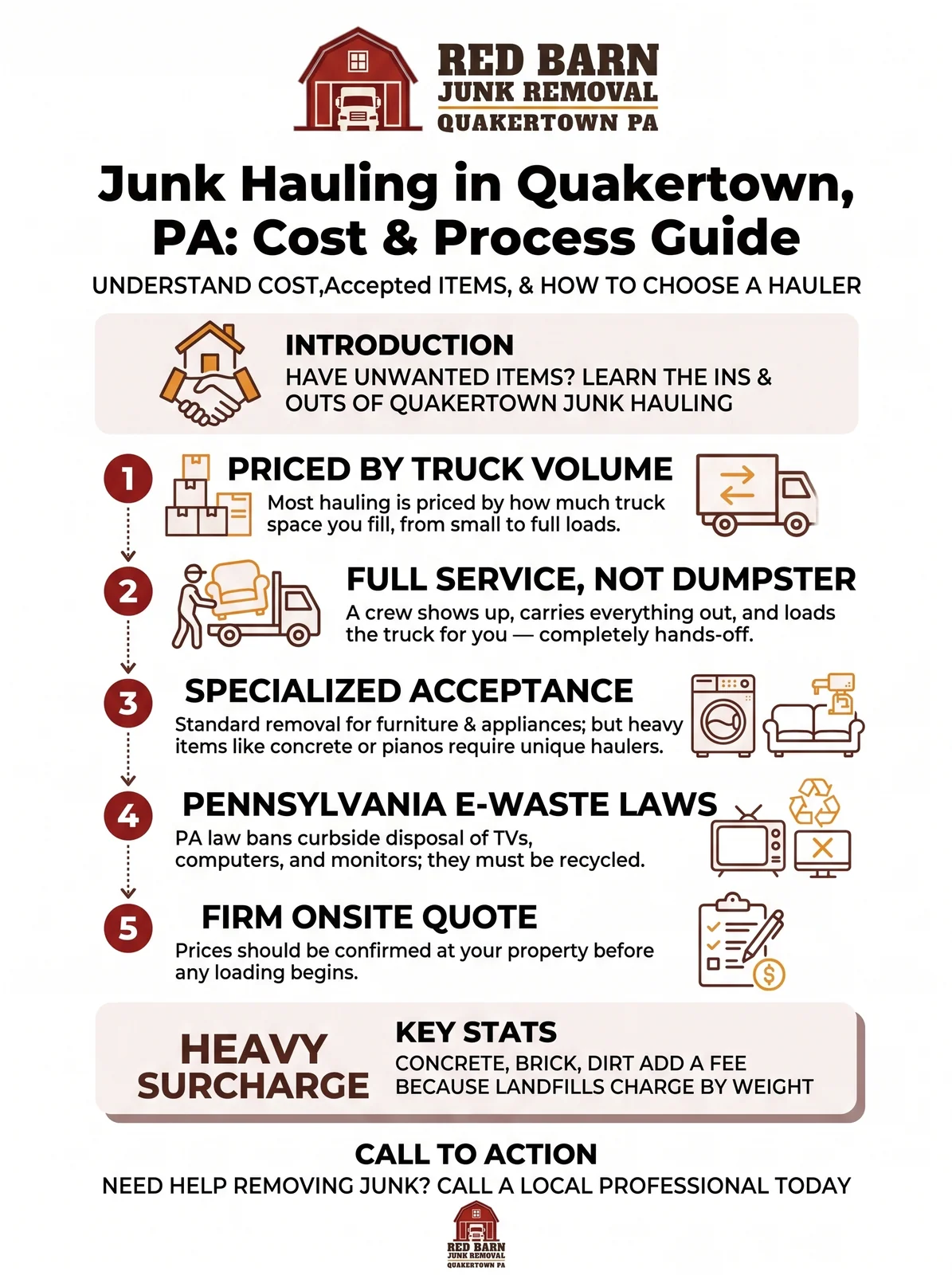
Junk hauling in Quakertown means a crew comes to your property, does the lifting, loads your unwanted items onto a truck, and disposes of them responsibly — typically priced by how much truck space you fill, not by weight. Across Quakertown and Upper Bucks County, standard furniture and appliance removal is common, but heavy materials like concrete, oil tanks, and pianos require specialized haulers. This guide walks through cost, the step-by-step process, what’s accepted, and how to choose a hauler.
What you need to know
Most junk hauling is priced by truck volume, from a small minimum load up to a full or extra-large load.
Heavy material like concrete, brick, and dirt usually adds a surcharge because landfills charge haulers by weight.
Pennsylvania law bans curbside disposal of TVs, computers, and monitors — these require certified e-waste recycling.
A firm price should be confirmed at your property before anything gets loaded, not adjusted afterward.
Rural Upper Bucks properties — barns, oil-heated farmhouses, borough row homes — often need a hauler with specific access experience.
What Junk Hauling Actually Means
Junk hauling is a full-service removal job: a crew shows up, carries out whatever you point to, loads it onto a truck, and hauls it away for disposal, donation, or recycling. That’s different from a dumpster rental, where a container is dropped off and you do the loading yourself over days or weeks. It’s also different from routine curbside trash pickup, which is limited to bagged household waste and won’t touch bulky or regulated items.
Full-service hauling includes the labor. You don’t drag a mattress down two flights of stairs or wrestle a dead refrigerator into a truck bed — the crew does that part, then sweeps up when they’re done.
Junk Hauling vs. Dumpster Rental vs. Curbside Trash
Each option fits a different situation. A dumpster makes sense for a multi-week renovation where debris accumulates gradually and you’re willing to load it yourself. Curbside pickup works for routine weekly household waste, but most municipal services — including trash removal Quakertown residents rely on — won’t take large furniture, appliances, electronics, or construction debris.
Full-service hauling is the option for a single-day cleanout with no labor on your end: a basement full of decades of storage, a barn that needs clearing, or a property that has to be emptied before a settlement date. If you’re weighing the container-and-DIY route against a crew that does it all, it’s worth comparing costs and timelines directly — see this dumpster rental alternative breakdown before deciding.
How Junk Hauling Is Priced in the Quakertown Area
Most junk hauling in this region is priced by volume — how much of the truck your items fill — rather than by weight. Pricing typically runs on a ladder: an eighth-load minimum, then quarter, half, and three-quarter loads, up through a full load and an extra-large load. As a reference point, a full load commonly runs around $695 and an extra-large load around $899, though every provider sets its own numbers, so confirm current pricing directly.
A responsible estimate — whether from photos or an on-site visit — gives you a range up front. The firm number gets confirmed once the crew is actually standing in your driveway and can see the real volume. That’s not a bait-and-switch; it’s just how volume-based pricing works when a photo can’t capture everything.
Load Size
What It Typically Fits
Approx. Reference Price
1/8 load (minimum)
A few bags, a small appliance, one or two furniture pieces
Lowest tier — confirm with provider
1/4 – 1/2 load
A single room’s worth of furniture and boxes
Mid-range
3/4 load
A full garage or small basement
Upper-mid range
Full load
A packed basement, attic, or several rooms
~$695 [verify current pricing]
Extra-large / big truck
Whole-house or estate-level cleanouts
~$899 [verify current pricing]
Why Heavy Materials Cost More
Concrete, brick, dirt, and excavated soil are priced differently than a couch or a box of clothes. Landfills and transfer stations charge haulers by weight for this material, so a hauler that accepts it typically adds a surcharge — commonly in the $100–150 range per load — on top of the standard volume price. This isn’t a hidden fee when it’s disclosed up front; it reflects a real cost the hauler absorbs at the dump. It’s also worth knowing that most general junk-removal companies refuse heavy material entirely, so if your job includes a torn-out patio or a pile of construction debris, confirm the hauler actually takes it before you book.
Travel Fees and Service Radius
Haulers dispatched from outside your immediate area sometimes add a travel fee — commonly somewhere between $25 and $99 — once a job falls outside their core operating zone. A hauler genuinely based nearby is more likely to waive that fee within a set radius, say 15 miles. This is a fair, simple question to ask when comparing quotes: is there a travel charge to my address, and at what distance does it kick in?
What a Typical Junk Hauling Job Looks Like, Step by Step
The process is fairly consistent across the industry, from first contact to a swept-clean finish.
Step 1 — Getting an Estimate
Most jobs start with either a photo estimate or an on-site visit. For a photo estimate, a wide shot of the whole pile, a second angle showing depth, close-ups of anything heavy or awkward, and a photo of the access path (stairs, doorways, parking distance) all matter — access affects labor, and labor affects price. A good estimate is presented as a range, with the exact number confirmed once the crew arrives.
Step 2 — Scheduling and Booking
Expect an arrival window rather than an exact time — a two-to-three-hour range is standard. Many haulers now take a card to hold your slot, only charging it once the job is actually complete. Same-day service is often possible but depends on truck availability and whether the local transfer station is open that day, since dump sites close on holidays and some weekends. Cancellation policies vary, but a free cancel or reschedule window up to 24 hours before the appointment is common practice.
Step 3 — The Crew Arrives and Removes the Items
On arrival, the crew should walk the property, confirm the firm price with you, and get your approval before anything gets loaded. From there, they handle all the lifting — out of a basement, an attic, a barn loft, or straight off the curb. Interior jobs typically include floor and doorway protection, and the crew should leave the space broom-clean when finished.
Estimate given (photo or on-site), presented as a range.
Booking confirmed with an arrival window and card on file.
Crew arrives, walks the property, confirms the firm price.
Items are carried out, loaded, and the space is swept clean.
Payment collected on completion.
Step 4 — Disposal, Recycling, and Payment
What happens to your items after they leave your property varies by category: usable furniture may go to donation, metal and appliances typically go to scrap recyclers, electronics go to certified e-waste processors, and general debris goes to a transfer station. Payment is usually due on completion, commonly by card, Venmo, or CashApp rather than a mailed invoice.
What Junk Haulers Take — and What They Can’t
Knowing what’s accepted before you call saves everyone time.
Commonly Accepted Items
Furniture — couches, tables, mattresses, and box springs, often through a dedicated furniture removal service
Appliances, including Freon units like refrigerators, freezers, and window AC units
Electronics and e-waste — TVs, monitors, computers, printers
Garage, basement, attic, and shed cleanout debris
Yard debris, brush, overgrowth, and storm damage, handled through yard waste removal
From specialized haulers only: concrete, brick, dirt, pianos, heating-oil tanks, radiators, scrap metal, and granite or marble slabs
Not every hauler takes the last category — heavy and specialty material is exactly where general junk-removal companies tend to say no.
Items That Can’t Be Hauled (and Where They Go Instead)
Asbestos and asbestos-containing material
Paint, solvents, chemicals, and pesticides — Bucks County runs household hazardous waste collection events for these
Motor oil and cooking oil — transfer stations generally refuse liquid oils outright, so haulers can’t take them either
Propane tanks and other flammables
Medical and biohazard waste
Regulations That Affect Junk Hauling in Pennsylvania
A few rules shape what a hauler can legally do, and knowing them explains some of the disposal decisions above.
Why Your TV, Computer, or Monitor Can’t Go in the Trash
Since 2013, under Pennsylvania’s Covered Device Recycling Act (Act 108 of 2010), trash haulers have not been permitted to accept TVs, computers, or monitors as part of routine curbside collection. These devices legally have to go through certified electronics recycling. Quakertown Borough publishes its own list of unacceptable curbside items for the same reason — it’s why choosing a hauler that handles e-waste correctly actually matters, rather than being a nice-to-have.
Refrigerant and Appliance Handling
Appliances that contain Freon — refrigerators, freezers, and many air conditioning units — fall under EPA refrigerant-handling rules. That’s another reason these units can’t just be tossed out with regular trash or handled casually; proper removal requires a hauler equipped to manage refrigerant correctly.
Contractor Registration in PA
Light demolition and interior tear-out work fall under Pennsylvania’s Home Improvement Consumer Protection Act, which requires registered contractors to display a registration number on advertisements, estimates, and contracts. If a hauler publishes a checkable number — for example, “PA Contractor #PA112494” — that indicates they’re registered under this law. It’s worth checking, though registration on its own isn’t a guarantee of quality; it’s one data point among several.
How to Choose a Junk Hauling Company in Quakertown
A few practical checks separate a straightforward job from a frustrating one. Confirm the price is given up front and locked in before anything gets loaded — not adjusted after the truck is already half full. Ask whether surcharges for heavy material or travel are disclosed in advance rather than sprung on you at the curb. Check whether the company actually takes the specific items you have, especially anything heavy or unusual. Consider whether the hauler is genuinely based nearby versus dispatched from two counties away, and look for a real operating history — years in business, completed jobs, and reviews you can actually read. For a fuller rundown, this guide on choosing a junk removal company goes deeper into vetting criteria.
Questions to Ask Before You Book
Is the price based on volume or weight, and what’s included in that number?
Do you take [my specific heavy or specialty item]?
Is there a travel fee to my address, and at what distance does it start?
Do you do the lifting, or do I need to move things to the curb myself?
What’s your cancellation and rescheduling policy?
Are any surcharges disclosed before I book, or only once the crew arrives?
Junk Hauling for Barns, Farms, and Older Homes in Upper Bucks
Upper Bucks properties aren’t uniform, and that changes what a job actually involves. A bank barn in Richland or Milford Township might have a hay loft reachable only by a fixed ladder, a corn crib packed with decades of scrap metal and old equipment, or an equipment shed nobody’s opened in years. These jobs need a crew that understands the access limits before quoting a price, not one used to a suburban two-car garage.
Older stone farmhouses off West End Boulevard or scattered through Richland Township frequently still have heating-oil tanks, radiators, and narrow, winding cellar stairs that make a straightforward dolly run impossible. Borough row homes closer to the center of town come with their own constraints — narrow interior staircases, rear alley access, and street parking to work around. A hauler quoting any of these like a standard modern basement is likely to under-price the labor involved, which usually means a surprise cost adjustment later.
Whole-property jobs — clearing out an estate, a hoarding situation, or a property ahead of settlement — combine several of these challenges at once. An estate cleanout service experienced with this kind of property typically prices more accurately from the start, because they’ve seen the access problems before.
Getting Help With a Junk Hauling Job in Quakertown
Red Barn Junk Removal of Quakertown is based locally and handles both standard cleanouts and the heavy material most general haulers turn down — concrete, brick, dirt, pianos, oil tanks, and scrap metal. The firm price is agreed at your property before anything gets loaded, and estimates are free with no obligation.
Have a basement, barn, or whole property that needs clearing? Call (215) 607-8804 or visit 127 S 5th St, Quakertown, PA for a free, no-obligation estimate.
Frequently Asked Questions
How much does junk hauling cost in Quakertown, PA?
Most jobs are priced by the truck space they fill, from a small minimum load up to a full load (around $695) or an extra-large load (around $899), figures worth confirming with the provider. Heavy materials like concrete or dirt typically add roughly $100–150 per load. A free estimate should give you a range, with the exact price confirmed once the crew is on site.
Is junk hauling priced by weight or by volume?
Most standard household junk is priced by volume — the truck space it takes up. Heavy materials like concrete and dirt effectively factor in weight too, since landfills charge haulers by the ton for that material, which is why it carries an added surcharge on top of the volume price.
Do I have to move everything to the curb myself?
No, not with full-service hauling. The crew carries items out from wherever they sit — a basement, attic, barn, or back field — and loads the truck themselves. That’s the main difference from a dumpster rental, where you’re responsible for loading the container yourself over time.
Can junk haulers take concrete, dirt, or an old oil tank?
Many general haulers refuse this kind of heavy or specialty material, but some haulers specifically take concrete, brick, dirt, pianos, heating-oil tanks, radiators, and scrap metal. Always confirm before booking, since heavy material usually adds a surcharge to the standard load price.
Why won’t the trash service take my old TV or computer?
Since 2013, Pennsylvania’s Covered Device Recycling Act has prohibited trash haulers from accepting TVs, computers, and monitors curbside. These devices legally must go through certified electronics recycling instead, which is why using a junk hauler equipped to handle e-waste correctly matters.
Can I get same-day junk hauling?
Same-day service is often possible, but it depends on truck availability that day and whether the local transfer station is open — dump sites close on holidays and many weekends. Booking earlier in the day, or a day ahead, generally improves your chances of getting same-day service.
What items can’t a junk hauler take at all?
Standard exclusions include asbestos, paint and household chemicals, pesticides, motor and cooking oil, propane tanks and other flammables, and medical or biohazard waste. Most of these need to go to a Bucks County household hazardous waste collection event rather than onto a hauler’s truck.
Red Barn Junk Removal has cleared barns, basements, garages and whole properties across Quakertown and Upper Bucks County since 2015 — over 1,000 completed jobs, 2–3 trucks on the road daily, and a crew of nine to eleven working out of 127 S 5th St. The company takes what most haulers turn down over the phone: concrete, brick and excavated soil, pianos, heating-oil tanks, cast-iron radiators and farm scrap. Every guide on this site comes out of what the crews actually meet on Upper Bucks properties — stone farmhouses with winding cellar stairs, bank barns with ladder-only lofts, and borough row homes with one narrow staircase. Registered Pennsylvania Home Improvement Contractor, PA #PA112494.