(215) 607-8804Crews on the road 6 AM to 6 PM, Monday to Saturday. Phones answered 24/7 — outside crew hours an automated assistant takes your details and books your free on-site estimate.
PA Contractor #PA112494 · 10+ years · 1,000+ jobs
Based at 127 S 5th St, Quakertown, PA 18951
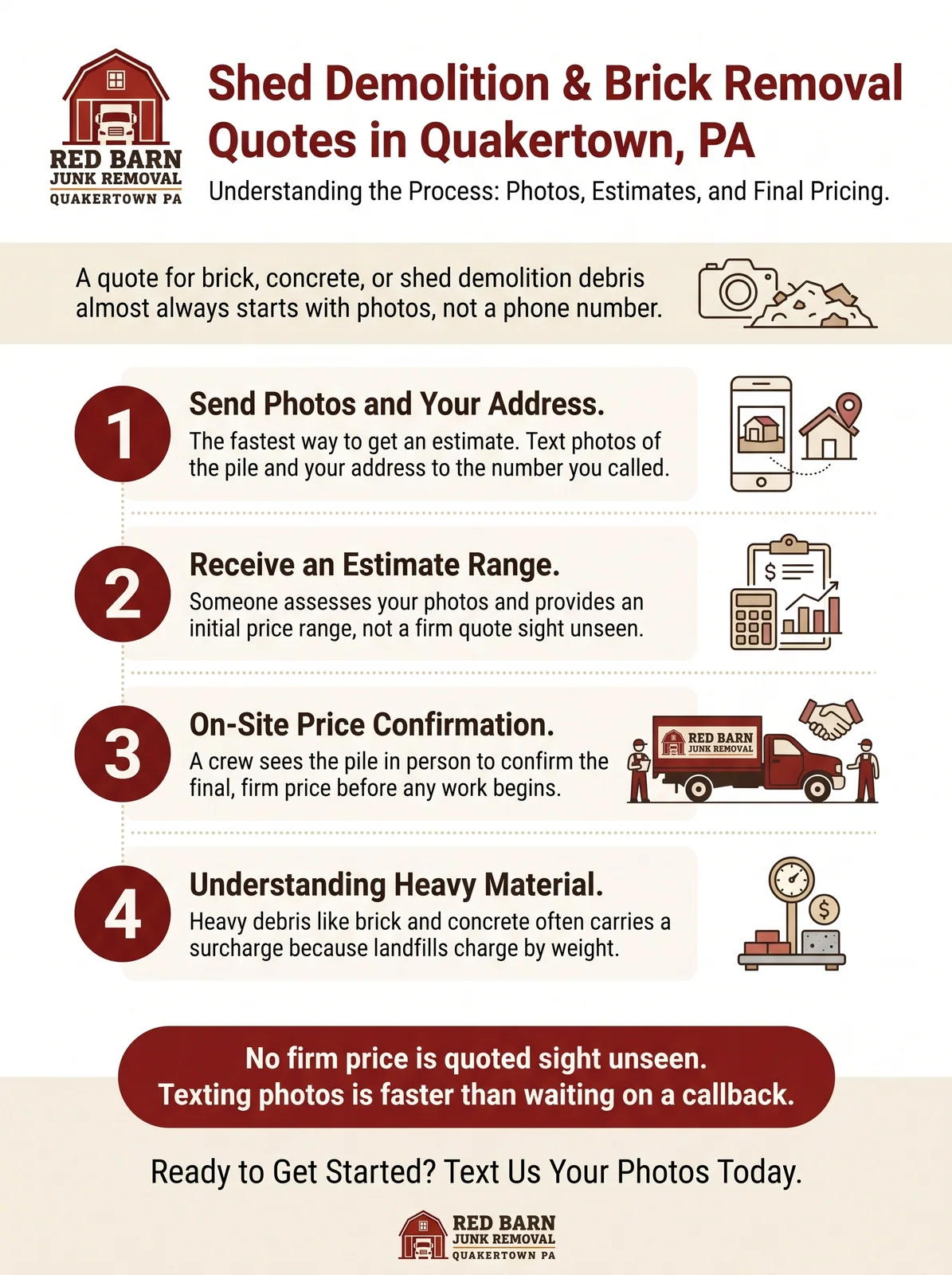
To get a quote for brick, concrete, or shed demolition debris, you send a few photos of the pile plus your address. Someone assesses the photos, gives you an estimate, and confirms a firm price once a crew actually sees the pile. No number gets handed out over the phone before that — not because anyone’s stalling, but because heavy debris can’t be priced blind.
What You Need to Know Before You Call
A quote for brick, concrete, or shed demolition debris almost always starts with photos, not a phone number.
Texting photos and your address to the same number you called is usually faster than waiting on a callback.
An online form rarely captures enough detail on its own — expect a follow-up call or text request for pictures.
No firm price gets quoted sight unseen. What you get first is a range; the final number is confirmed at the property.
Heavy material like brick and concrete often carries a surcharge on top of standard load pricing, because landfills charge by weight.
The Fastest Way to Get an Estimate: Send Photos and Your Address
Here’s the part that trips people up. You fill out a form on a laptop, it tells you to call, and then whoever answers asks you to text photos to that same number. It feels like three steps for one answer. It isn’t, really — it’s one process wearing three hats.
The form collects your name and a general idea of the job. The call connects you to an actual person who can tell you what’s needed next. The text is where the real information lives: what the pile looks like, how big it is, and whether a truck can get close to it. Skip the text step and nobody can give you a number worth trusting.
Brick from a torn-down shed is a good example. “Some brick and stuff from a shed being demolished” could mean a wheelbarrow’s worth, or it could mean two tons stacked against a fence line. A photo answers that question in about four seconds. A verbal description doesn’t.
What Photos to Send for an Accurate Estimate
Send these five, and the estimate you get back will actually hold up once a crew arrives:
A wide shot of the whole pile, taken from a few steps back so the full size is visible.
A second angle showing depth. A pile photographed straight-on hides half of what’s actually there — this one shot prevents most low estimates.
A close-up of anything heavy or awkward — broken concrete, a slab, rebar sticking out of brick, anything that isn’t just loose debris.
The access path — the driveway, gate, or side yard a truck or wheelbarrow would need to use to reach it.
Something for scale — a door, a car, even your own foot in frame. Without it, a photo has no sense of size at all.
Five photos. Maybe two minutes of your time. That’s the whole trick to getting a number that doesn’t change later.
Why a Firm Price Can’t Be Given Over the Phone
Heavy material is priced two ways at once — by how much space it fills on a truck, and by how much it weighs. A dispatcher on the phone can see neither. So instead of guessing, the honest answer is a range from your photos, with the real number confirmed once the crew is standing in front of the pile.
That’s not a runaround. It’s the only way to avoid the opposite problem — a number quoted blind over the phone that turns out to be wrong once someone sees eight hundred pounds of brick instead of a few loose chunks. A quote that moves without warning is worse than a quote that takes an extra text message to produce.
Online Form, Phone Call, or Text — Which One Actually Gets You a Quote
Short answer: all three, used in the right order. None of them is the “real” step on its own. Here’s roughly how each one functions, and why the process can feel longer than it needs to.
Channel
What it actually does
What it still can’t do alone
Online form
Captures your name, number, and a rough description of the job
Can’t show volume, weight, or access — no number comes from this step
Phone call
Connects you to a real person, confirms the job type, explains next steps
Can’t produce a firm price without seeing the material
Text with photos
Gives the estimator the visual information needed to produce a real range
Still needs an on-site confirmation before the price is locked in
A full-size estate cleanout, a basement full of furniture, and a pile of torn-out shed brick don’t get quoted the same way, even though they all start with the same form. Something like an estate cleanout usually needs a walk-through or a wider set of photos simply because there’s more to account for room by room. A single couch pickup through a furniture removal service is closer to a yes-or-no — far less back-and-forth, because there’s nothing hidden in a sofa’s weight or volume.
What Happens After You Submit the Online Form
Forms are built for speed, not detail. They’re good at telling someone you exist and you need help — they’re bad at showing what’s actually sitting in your yard. So the next step is almost always a call or a text asking for photos. That’s not a sign the form failed. It’s the form doing its one job and handing off to the step that can actually do the rest.
Removing Brick, Concrete and Shed Demolition Debris: What to Know
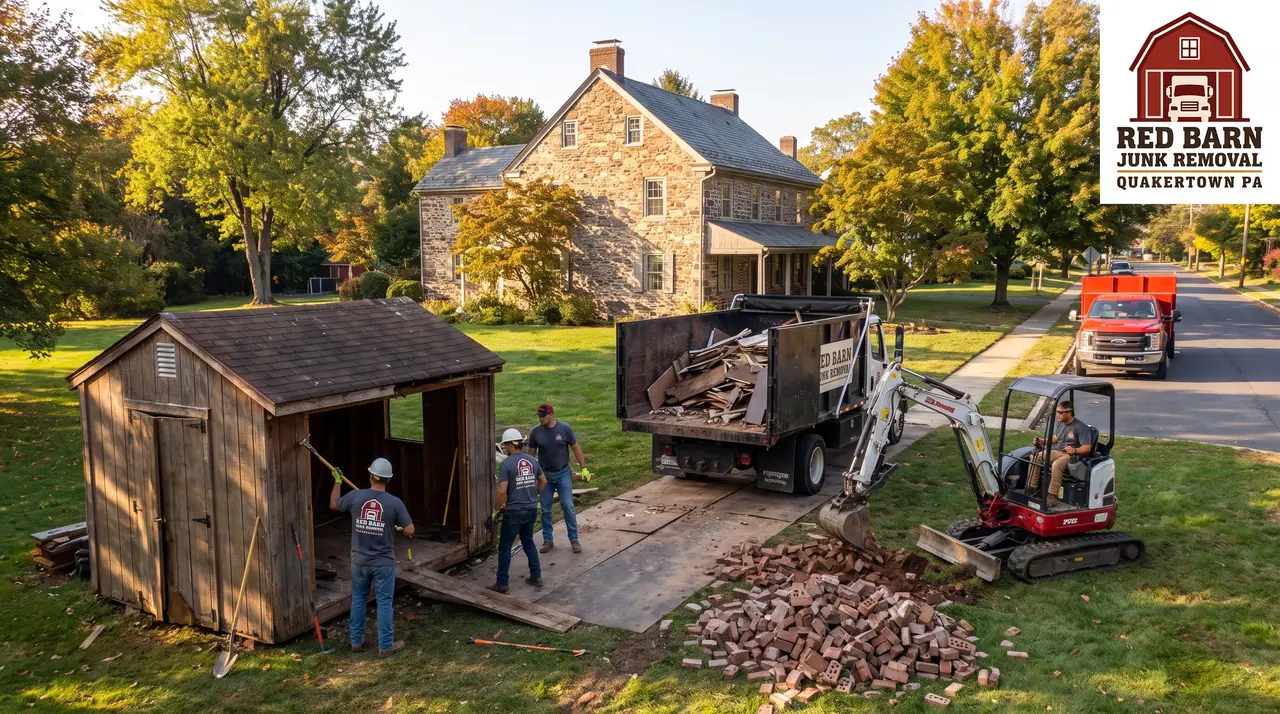
Not every hauler takes this kind of material. Brick, broken concrete, and dirt are heavy in a way that furniture and boxes aren’t, and plenty of standard junk removal outfits simply pass on it. If you’ve got shed demolition debris sitting in a pile, it’s worth confirming up front that whoever you’re calling actually handles it — rather than finding out after they’ve already shown up.
Shed teardowns rarely stop at brick and lumber, either. There’s often a tangle of yard growth around the old foundation, maybe a section of fencing, sometimes scrap metal from hinges or a collapsed roof. If your project also left behind overgrown brush or cut branches, a yard waste removal pickup can usually be handled on the same visit rather than as a separate job.
Renting a dumpster is the other option a lot of people consider for this kind of project. It works, but it also means paying for the container whether it’s half full or overflowing, plus a pickup fee on top. For a one-time pile like leftover shed material, a dumpster rental alternative that prices by the load tends to come out simpler, and nothing sits in your driveway for a week waiting to be picked up.
Understanding Heavy Material Pricing (By Volume, Plus Weight)
Standard loads are priced by how much space they take up on a truck. Heavy material adds a second layer on top of that, because transfer stations charge by weight, not by cubic feet. A truck bed that’s only a quarter full of broken concrete can still weigh more than a full load of couches and boxes.
That’s why brick and concrete usually carry a published surcharge rather than getting folded quietly into the base price. It’s not an upsell — it’s a cost that exists whether or not anyone mentions it, so the honest move is to say so before you book, not after the truck’s already loaded.
What Isn’t Accepted — and Where It Goes Instead
A few things turn up around demolition sites that don’t belong in a standard load at all:
Asbestos or any material suspected to contain it — especially relevant in older sheds and outbuildings
Paint, solvents, and household chemicals — these route to a household hazardous waste collection event, not a junk truck
Motor oil or cooking oil — transfer stations won’t accept liquid oils, full stop
Propane tanks and other flammables
Medical or biohazard waste
Everything else — brick, concrete, dirt, scrap wood, old hardware — is fair game for a regular pickup. If you’re also clearing out general household junk alongside the demolition pile, a trash removal Quakertown visit can usually fold both into one stop instead of two separate appointments.
A Simple Checklist Before You Request Your Quote
Before you text anyone a single photo, run through this short list. It takes less time than reading this paragraph did.
Before you request your estimate
Seven small checks. That’s really all an accurate quote for shed demolition debris requires — the rest is just someone on the other end doing their math.
If you’re in or around Quakertown with brick, concrete, or shed demolition debris to clear, text a few photos and your address to (215) 607-8804 for a free, no-obligation estimate from Red Barn Junk Removal of Quakertown.
Frequently Asked Questions
How do I get a quote for brick or shed demolition debris?
Text a few photos of the pile along with your address to the number you called. The estimator assesses the photos and gives you a range, then confirms the firm price once a crew sees the material at your property, before anything gets loaded.
Can I just text photos instead of filling out the online form?
Yes. Texting photos to the number you called is often the fastest path to an actual estimate. The online form is useful for logging your basic details, but it’s the photos and your address that let anyone give you a real number.
Why won’t they give me a price over the phone?
Heavy material is priced by both volume and weight, and neither can be judged over a phone call. A reasonable estimator gives a range from photos, then locks in the firm price on site, before loading starts — so nothing changes on you after the fact.
What photos should I send for the most accurate estimate?
A wide shot of the full pile, a second angle showing depth, a close-up of anything heavy or oddly shaped, a shot of the access path, and something in frame for scale. The depth photo and the access photo are the two that matter most.
Do junk removal companies take leftover material from a demolished shed?
Many do, including brick, concrete, and general construction debris, though plenty of standard haulers turn heavy material away outright. Worth confirming acceptance before you send photos, rather than assuming — and if you’re weighing options, a guide to choosing a junk removal company covers what else is worth asking.
Is there an extra charge for heavy material like brick and concrete?
Usually, yes. Because disposal sites charge by weight rather than by volume, brick and concrete commonly carry a surcharge on top of standard load pricing. A straightforward estimator states that upfront, before you book, rather than adding it once the truck shows up.
Red Barn Junk Removal has cleared barns, basements, garages and whole properties across Quakertown and Upper Bucks County since 2015 — over 1,000 completed jobs, 2–3 trucks on the road daily, and a crew of nine to eleven working out of 127 S 5th St. The company takes what most haulers turn down over the phone: concrete, brick and excavated soil, pianos, heating-oil tanks, cast-iron radiators and farm scrap. Every guide on this site comes out of what the crews actually meet on Upper Bucks properties — stone farmhouses with winding cellar stairs, bank barns with ladder-only lofts, and borough row homes with one narrow staircase. Registered Pennsylvania Home Improvement Contractor, PA #PA112494.