(215) 607-8804Crews on the road 6 AM to 6 PM, Monday to Saturday. Phones answered 24/7 — outside crew hours an automated assistant takes your details and books your free on-site estimate.
PA Contractor #PA112494 · 10+ years · 1,000+ jobs
Based at 127 S 5th St, Quakertown, PA 18951
The best junk removal company in Quakertown depends on the job in front of you. A homeowner clearing a garage wants something different from a farm owner emptying a barn or a property manager turning over a rental. Across Bucks County and Upper Bucks, the strongest options share a few traits: a real Pennsylvania contractor registration number, a genuinely local base, transparent pricing, and the ability to handle whatever material the job actually produces — including heavy material many haulers won’t touch.
What “Best” Actually Means for Junk Removal in Quakertown
There’s no single ranking that fits every situation. A cleanout job in a Broad Street row home is a different problem than clearing a bank barn in Milford Township, and both differ from a multi-unit rental turnover on a property manager’s schedule. “Best” really means “best fit for this job” — the right capacity, the right material list, and the right process for how the property is accessed.
Instead of chasing a star rating, treat this article as a checklist. Run any company you’re considering through the same seven questions, and you’ll spot the difference between a reliable operation and one that’s improvising.
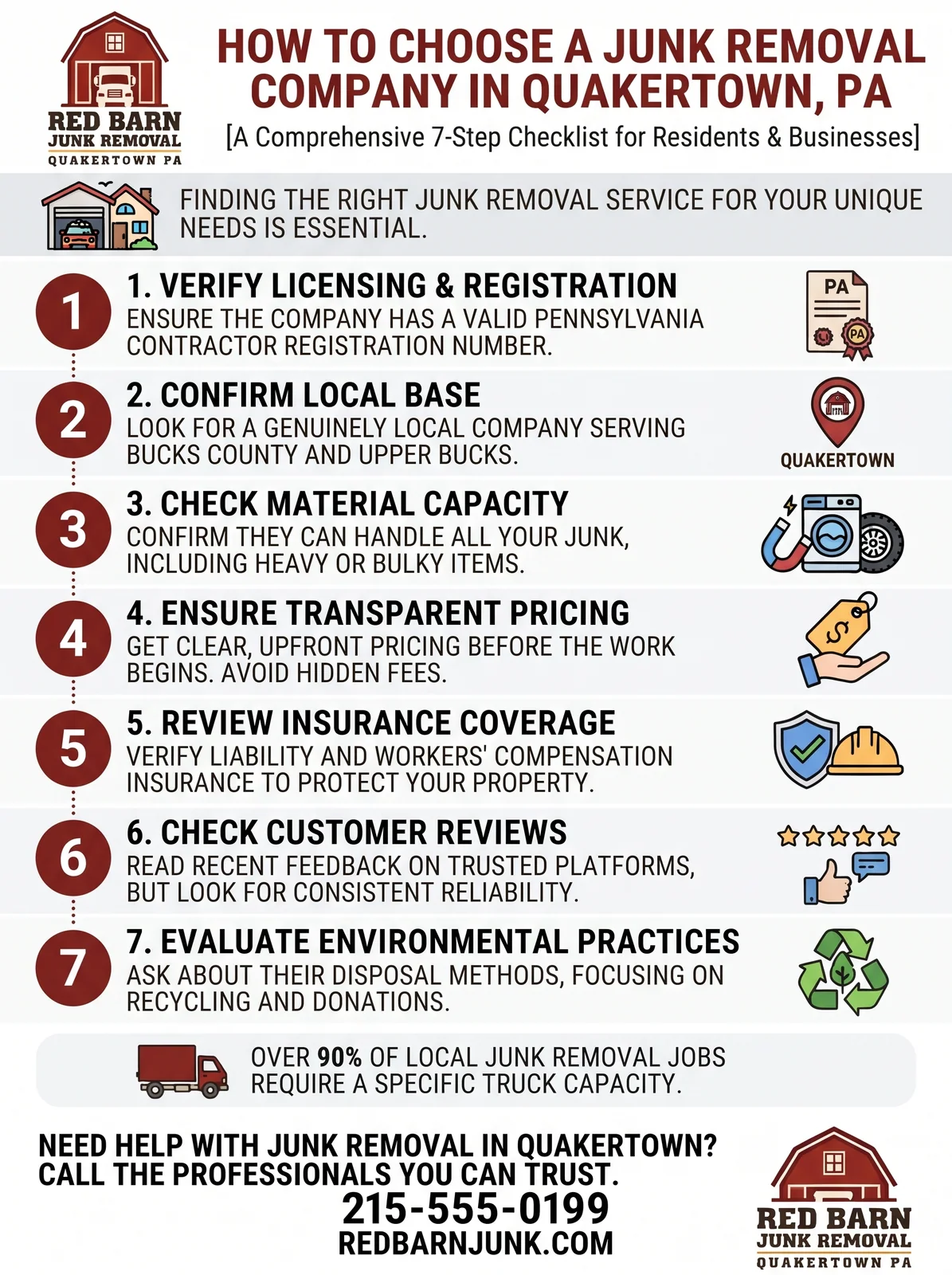
The 7 Things to Check Before Hiring Any Junk Removal Company
These are the questions that separate an established outfit from someone with a truck and a Craigslist ad. None of them require special knowledge — just a few minutes on the phone or on the company’s website.
Is the Company Licensed and Registered?
Pennsylvania’s Home Improvement Consumer Protection Act requires registered contractors to display their registration number on advertisements, estimates, and contracts [verify: exact HICPA advertising requirement wording]. Before you book, look for a checkable “PA Contractor #” or “PA Home Improvement Contractor #” and verify it directly at hicsearch.attorneygeneral.gov. Many junk-hauling operations in this market don’t publish a number at all — which is itself worth noting.
One distinction matters here: “licensed” or “registered” is not the same claim as “insured.” A contractor registration confirms the business is on file with the state; it says nothing about liability coverage. Ask about each separately instead of assuming “licensed and insured” covers both — plenty of companies advertise the phrase without holding both pieces.
Where Is the Company Actually Based?
Dispatch location affects response time, routing, and how well a crew knows the local property stock. Several companies that show up in Quakertown search results actually dispatch from Hatfield, roughly 13 miles away, or Warminster, about 20 miles out — and a few operate purely as national marketplaces behind an 800 or 844 number. A company with a real local address and a 215 or 267 area code is worth a second look, simply because it’s a signal you can verify rather than take on faith.
How Do They Price the Job?
Reputable junk removal is usually priced one of two ways: by volume (the truck space your items fill) or by weight. Volume pricing is the more common and more predictable model for household and property cleanouts, and it should come with a free estimate up front.
The real question isn’t which model a company uses — it’s whether surcharges are disclosed before you book or discovered once the truck is in the driveway. Ask directly: is there a heavy-material add-on? A travel fee outside a certain radius? A company that answers clearly, before quoting a number, is telling you something about how it operates.
Do They Offer a Free, No-Obligation Estimate?
A free estimate — from photos or an on-site visit — is standard practice among established companies. What’s worth understanding is that a photo estimate should always be a range, not an exact figure. A pile photographed straight-on can hide half its actual volume, which is exactly how under-quoting happens.
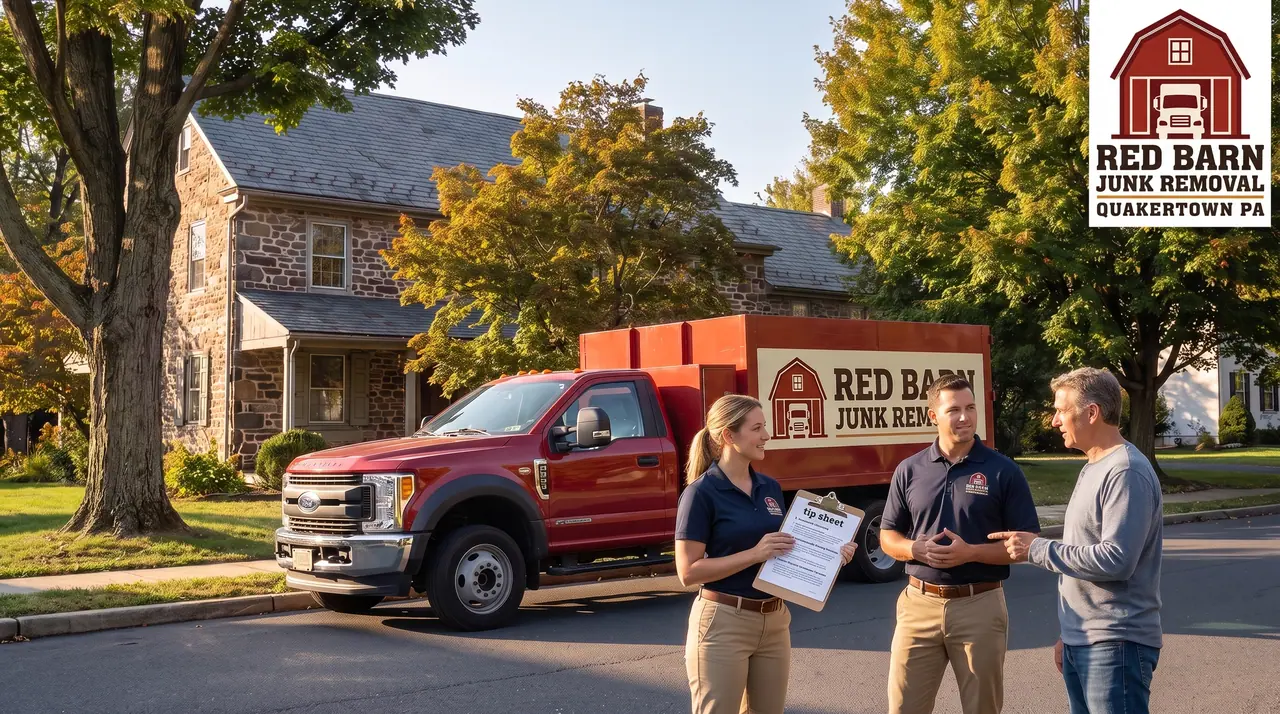
If you’re sending photos for an estimate, four shots make a real difference:
A wide shot of the whole pile or room from the doorway
A second angle that shows depth, not just the front of the pile
A close-up of anything heavy or unusual — an appliance, a piano, a slab
A shot of the access path — stairs, doorway width, distance to where a truck can park
What Materials Will They Actually Take — and Refuse?
This is where companies genuinely differ. Most junk removal outfits handle furniture, appliances, and general household clutter without issue. Fewer are equipped — or willing — to take heavier or more awkward material.
Pianos (upright & grand), heating-oil tanks, boilers, radiators, scrap metal
Rarely offered by general haulers
Hazardous / prohibited
—
Asbestos, paint/solvents/chemicals, motor & cooking oil, propane, medical waste
Liquid oils in particular trip up a lot of homeowners — transfer stations generally refuse motor oil and cooking oil outright, regardless of who’s hauling it. If you have a heating-oil tank, a piano, or a load of construction debris, confirm the specific item before booking rather than assuming any company will take it.
Can They Handle the Size of Your Job?
Capacity is a fit question as much as a quality one. A single-truck operator physically cannot clear a full estate, a hoarding situation, or a multi-unit rental turnover in a reasonable window — it’s not a matter of willingness, it’s a matter of how many loads one truck can run in a day. If your job is large, ask directly how many trucks the company runs and whether they’ve quoted multi-load properties before.
Reviews, Track Record, and How They Handle Problems
Read reviews for patterns, not just star counts. Look specifically for mentions of surprise charges after the quote, no-shows, or how a company responded when something went wrong — that response tells you more than a five-star average does. Years in business and a completed-job count are meaningful signals in a trade with high turnover, where new operators appear and disappear every season.
Worth knowing: the FTC’s rules against fake and incentivized reviews mean a wall of suspiciously uniform five-star reviews, with no negative feedback ever, is itself a mild red flag rather than pure reassurance [verify: current FTC fake-review rule reference].
Types of Junk Removal Jobs and What to Expect
Before comparing companies, it helps to understand the landscape of jobs they actually handle. Each type has its own expectations around access, pricing, and documentation.
The most common calls involve furniture, appliances, general household clutter, and often yard debris from an overgrown lot. A dedicated furniture removal service or broader residential cleanout typically covers this tier. One detail worth knowing: since 2013, Pennsylvania law has barred trash haulers from accepting “covered devices” — TVs, computers, and monitors — under the Covered Device Recycling Act [verify: Act 108 of 2010 effective date detail]. A company that handles e-waste through certified electronics recycling is doing something your curbside trash service legally can’t.
Heavy Material and Specialty Removal
Concrete, dirt, pianos, oil tanks, and scrap metal form a specialty tier that most general haulers avoid, largely because landfills charge by weight for this material and it requires different equipment to move safely. In Upper Bucks specifically, oil-heated farmhouses and older barns commonly have exactly this kind of material sitting around — old tanks, radiators, and decades of scrap. A company that lists this capability explicitly is telling you something real about what they’re set up to do.
Whole-Property, Estate and Hoarding Cleanouts
Larger jobs require both capacity and a different kind of care. An estate cleanout or hoarding cleanout often means multiple truckloads, sorting through belongings that carry emotional weight, and scheduling around a settlement date or family timeline. Ask how a company documents the finished space and how they schedule multi-day jobs — the answer tells you whether they’ve actually done this before.
Rental Turnovers and Property Manager Cleanouts
Property managers and landlords have a narrower set of needs: lockbox or unattended access, doors secured after the crew leaves, same-day photo documentation, and clean invoicing. This is also where insurance stops being a nice-to-have — most property management companies require a Certificate of Insurance naming them as additional insured before they’ll issue a work order, regardless of how good the crew’s reputation is.
Understanding Junk Removal Costs in Quakertown
Most companies price by truck-load fraction — anywhere from a 1/8-load minimum up to a full or extra-large load — rather than by weighing every item. Heavy material and long-distance travel commonly add a surcharge on top of the base load price, since landfills bill by weight and fuel time adds up over distance.
Before booking, ask for the complete price structure: the load ladder, any heavy-material add-on, and whether a travel fee applies to your address. Some local companies waive the travel fee within a set radius of their base rather than charging it everywhere — worth asking about directly. As one example, Red Barn Junk Removal of Quakertown publishes its surcharges up front and charges no travel fee within 15 miles of its Quakertown address, which is the kind of detail that should be easy to find on any company’s site, not buried until the truck arrives.
If a full dumpster rental feels like overkill for your project, it’s also worth comparing the cost and hassle against a dumpster rental alternative that includes labor — sometimes the math favors a crew that loads everything for you over a bin sitting in your driveway for a week.
Local Rules That Affect Junk Disposal in Quakertown
A few local and state rules shape what happens to your items after pickup, and they’re worth knowing regardless of who you hire:
Quakertown Borough publishes an “Unacceptable Items” list for curbside trash — check it before assuming something can go out with regular pickup [verify: current borough list details]
TVs, computers, and monitors can’t legally go in regular trash under the Covered Device Recycling Act — they need certified electronics recycling
Household hazardous waste — paint, solvents, chemicals, pesticides — goes to Bucks County HHW collection events, not curbside or general hauling [verify: current county HHW program schedule]
Freon-containing appliances require professional refrigerant handling before disposal
Liquid oils, including motor oil and cooking oil, are refused at transfer stations and need a separate disposal path
If you’re weighing a full trash removal Quakertown option against handling items yourself, these rules are usually the deciding factor — a lot of “why won’t they take this” questions trace back to state or county regulation, not the hauler’s preference.
A Simple Checklist for Choosing Your Junk Removal Company
Before you book anyone, run through this list:
Verify a real PA contractor or home improvement registration number
Confirm the company’s actual base location and check for a local area code
Get a free estimate presented as a range, not a single fixed number over the phone
Confirm your specific materials — heavy items, oil tanks, pianos — are actually accepted
Check capacity: how many trucks, and have they handled a job your size before
Read reviews for patterns around surprise charges, no-shows, or damage handling
Get all surcharges — heavy material, travel — disclosed before you book, not on arrival
Ask about cancellation terms and whether payment is due only on completion
Getting a Free Estimate
Whatever company you choose, the right next step is a free, no-obligation estimate for your specific job — sent from a few photos or scheduled on site. If you’d like to compare a locally based option, Red Barn Junk Removal of Quakertown offers free on-site estimates across Quakertown and Upper Bucks County and can be reached at (215) 607-8804.
Not sure what your cleanout will cost? Get a free, no-obligation estimate — text a few photos or call (215) 607-8804 and get a real range before you commit to anyone.
Frequently Asked Questions
How much does junk removal cost in Quakertown, PA?
Most companies price by truck-load volume, starting at a 1/8-load minimum and scaling up to a full or extra-large load, with possible surcharges for heavy material and travel distance. A full load commonly runs in the several-hundred-dollar range. Get a free estimate and confirm the full price structure before booking.
Is junk removal priced by weight or by volume?
Most junk removal is priced by volume — the amount of truck space your items fill — rather than by weight. Heavy material like concrete, brick, or dirt is the exception, since landfills often charge haulers by weight for that category, which usually shows up as a separate surcharge.
Do junk removal companies in Quakertown take concrete, dirt, or pianos?
Not all of them. Many general haulers refuse heavy or awkward material, but some full-service local operators do take concrete, brick, dirt, pianos, and heating-oil tanks. Always confirm your specific item with the company before booking rather than assuming it’s covered.
Why won’t Quakertown Borough trash take my old TV?
Since 2013, Pennsylvania law has prohibited trash haulers from accepting “covered devices” — TVs, computers, and monitors — under the Covered Device Recycling Act. These items need to go through certified electronics recycling instead, which many junk removal companies handle as part of their service [verify: exact effective date and scope].
What should I ask before hiring a junk removal company?
Ask for their PA registration number, whether they carry liability insurance, how they price jobs (volume vs. weight), whether estimates are free, whether they take your specific material, and whether all surcharges are disclosed before you book. These six questions cover most of what separates a reliable company from a risky one.
Do junk removal companies offer same-day service in Quakertown?
Same-day service is often available, but it’s conditional — it depends on truck availability and whether the local transfer station is open that day. Many transfer stations close on holidays and some weekends, so don’t expect an unconditional same-day guarantee; ask the company directly whether today’s slot is realistic.
What can’t junk removal companies take?
Common exclusions include asbestos, paint, solvents, chemicals and pesticides, motor and cooking oil, propane and other flammables, and medical or biohazard waste. Items like these typically need to go to a Bucks County household hazardous waste collection event instead of a standard junk pickup.
If your project also involves clearing overgrowth or storm debris alongside household items, ask whether the same crew handles yard waste removal in one visit — it saves a second call and a second truck. And if you’re still comparing options after reading this, a closer look at choosing a junk removal company in more depth can help you narrow the list down to two or three real candidates before you pick up the phone.
Red Barn Junk Removal has cleared barns, basements, garages and whole properties across Quakertown and Upper Bucks County since 2015 — over 1,000 completed jobs, 2–3 trucks on the road daily, and a crew of nine to eleven working out of 127 S 5th St. The company takes what most haulers turn down over the phone: concrete, brick and excavated soil, pianos, heating-oil tanks, cast-iron radiators and farm scrap. Every guide on this site comes out of what the crews actually meet on Upper Bucks properties — stone farmhouses with winding cellar stairs, bank barns with ladder-only lofts, and borough row homes with one narrow staircase. Registered Pennsylvania Home Improvement Contractor, PA #PA112494.