(215) 607-8804Crews on the road 6 AM to 6 PM, Monday to Saturday. Phones answered 24/7 — outside crew hours an automated assistant takes your details and books your free on-site estimate.
PA Contractor #PA112494 · 10+ years · 1,000+ jobs
Based at 127 S 5th St, Quakertown, PA 18951
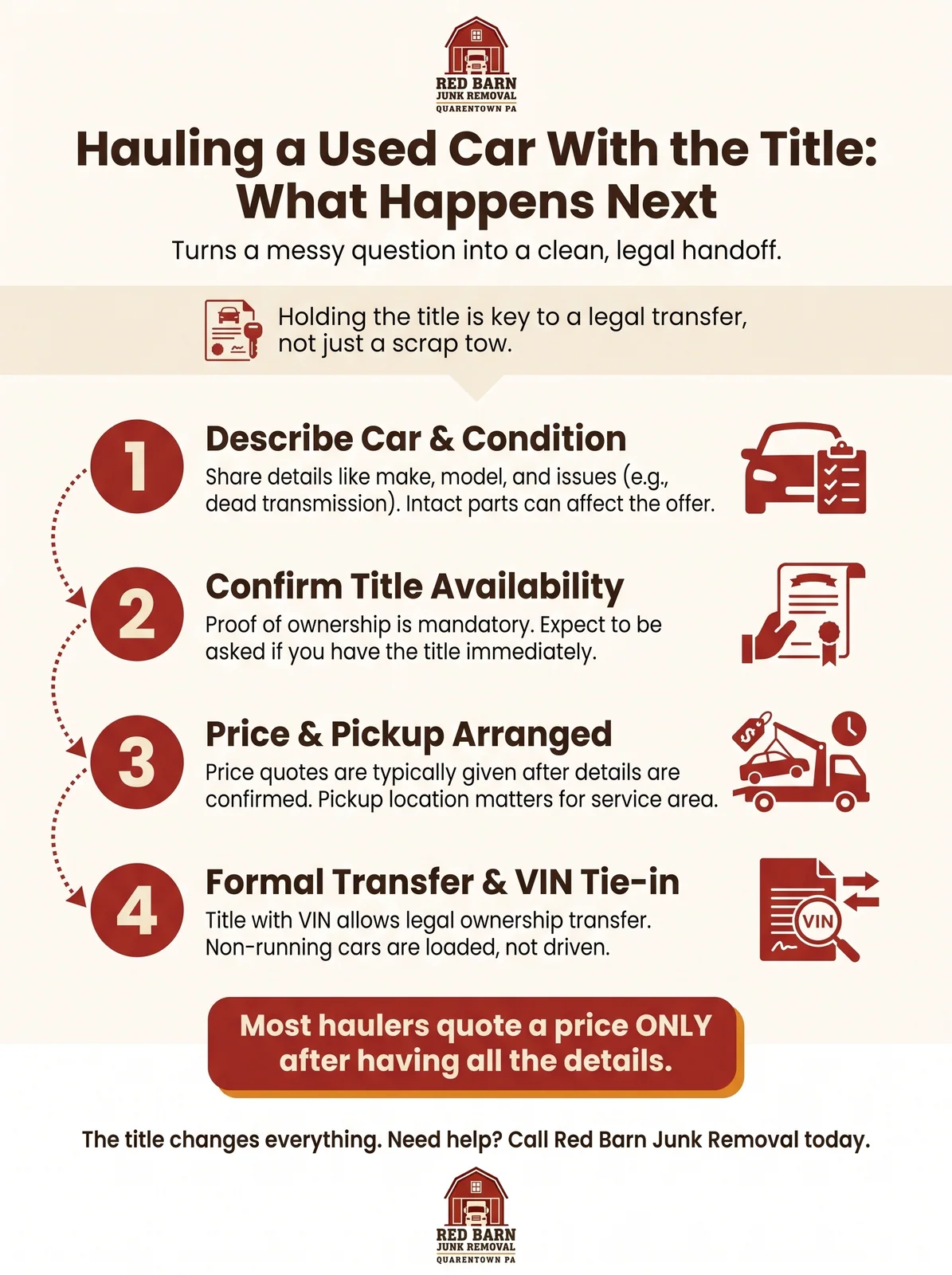
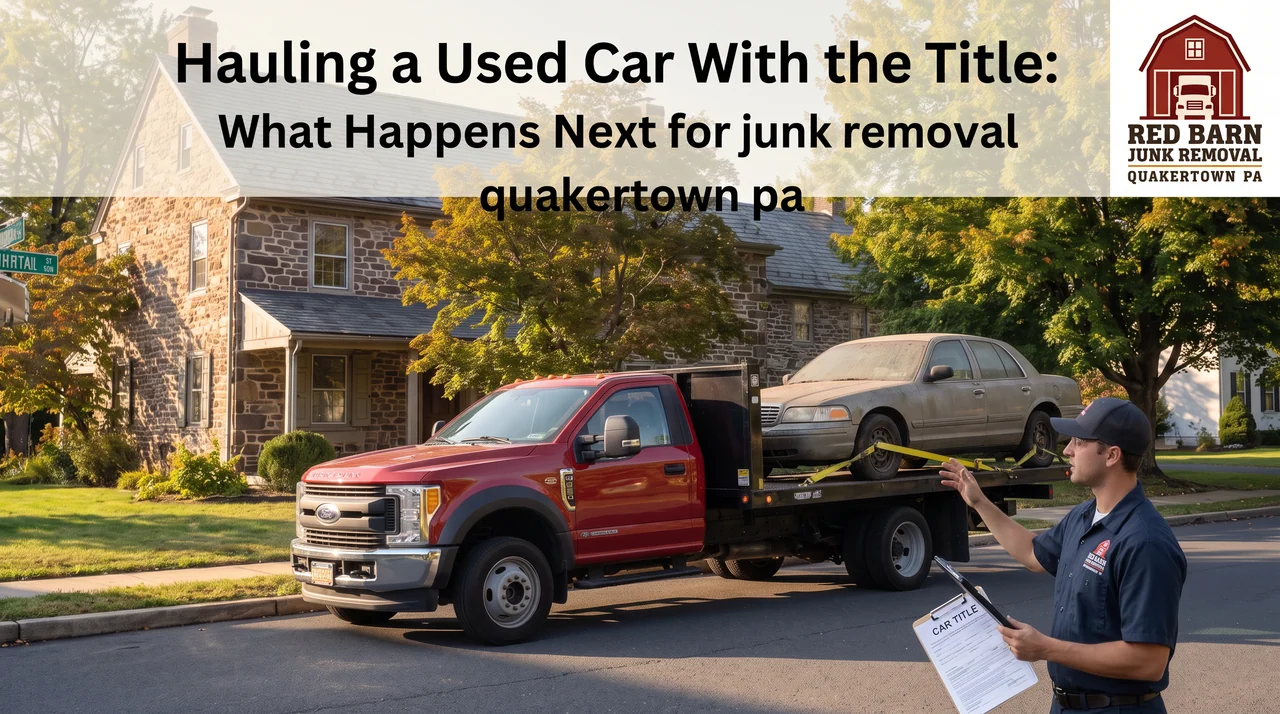
Yes, a used car can be hauled away when you still hold the title — and having it in hand is what turns a messy question into a clean, legal handoff. Take a real example: a 2002 Honda Civic with a blown transmission, owner says “I have the title.” That one detail changes the whole process. From there, the steps are simple: describe the car and its condition, confirm you have the title, and a price and pickup get arranged after that first call.
Holding the title means the car can be legally transferred, not just scrapped for parts.
A non-running car — even one with a dead transmission — can still be hauled; it’s loaded, not driven.
Intact original parts, like a catalytic converter, can affect the offer.
Most haulers don’t quote a price on the first call — they call back once they have the details.
Location matters, since some pickups fall outside a hauler’s core service area.
Why the title matters when hauling a used car
The title is your proof of ownership. Without it, a hauler has no legal way to confirm the car is yours to give up — which limits what they can do with it and, often, what they’ll offer you. With it, the car can be formally transferred out of your name, which is a very different transaction than someone just towing away scrap.
The title also carries the vehicle identification number (VIN), which ties the paperwork to the actual car. When you call about hauling a used car, expect to be asked whether you have the title before anything else gets discussed in detail.
What if you have the title in hand
This is the straightforward path — and it’s the exact situation in the Civic example. At pickup, bring three things: the physical title, a valid ID that matches the name on the title, and the keys if you still have them. You’ll typically sign the title over to the hauler on the spot, and the car is loaded and removed the same visit.
[verify] Pennsylvania may have specific signature or notarization requirements for transferring a title — check with PennDOT or ask the hauler what they need before pickup day.
What if the title is lost or missing
A missing title isn’t necessarily a dead end. In most states, you can request a duplicate title from the state motor vehicle agency before the transfer happens. [verify] Confirm the exact PennDOT process and timeline, since it can take longer than a same-week pickup.
Some haulers will still take a car without a title on hand, but they may ask for additional proof of ownership — registration, a bill of sale, or similar documents. A hauler that’s upfront about what they can and can’t legally take without a title is one worth trusting.
What condition means for a car that won’t run
“The transit’s gone” doesn’t disqualify a car from being hauled. A vehicle with a failed transmission, a dead engine, or one that simply won’t start can still be picked up — it’s loaded onto a truck or towed, not driven off your property. Drivability isn’t the deciding factor for whether a car can be hauled.
What it does affect is value. A complete car with its major parts intact is worth more than one that’s been stripped down. Rust, flood damage, and a missing engine all factor into the picture differently than a car that simply doesn’t run anymore.
How intact parts affect the picture — the catalytic converter example
Owners often mention specific parts unprompted — like “I believe it’s the original catalytic converters” — because they already sense it matters. Catalytic converters contain metals that hold real scrap value, and they’re a common target for theft. A car with its original, intact converter is generally viewed more favorably than one where it’s already been removed.
[verify] Exact scrap values shift with the metals market, so no fixed dollar figure should be assumed here. The same logic applies to other components — wheels, a working battery, or an intact engine can all factor into what’s offered.
What information a hauler asks for (and why)
The intake process is mostly about gathering the details that determine both the offer and the pickup plan. Here’s what typically gets asked, and why each piece matters:
Detail You Provide
Why It Matters
Year, make, and model
Establishes the base vehicle and its general market value
Title status (in hand, lost, or none)
Determines whether a legal transfer or an alternate process is needed
Running or non-running condition
Affects whether the car is towed, loaded, or driven, and how it’s priced
Notable parts (e.g., catalytic converter)
Intact original parts can raise the value of the offer
VIN
Confirms the vehicle’s identity and ties it to the title
Location and truck access
Determines if the pickup is within the hauler’s service area and how it’s scheduled
How the process works, step by step
Once you have the basics ready, the process from first call to pickup generally follows the same order:
You describe the vehicle — year, make, model, condition — and confirm whether you have the title.
That information gets passed along internally, and someone will reach out to you with next steps.
A price is given on that callback, once the details have been reviewed — not on the first call.
Pickup is scheduled, with an arrival window rather than an exact time.
At pickup, you sign the title over, and the car is loaded and hauled away.
What to bring at pickup
The physical title, signed where required
A valid photo ID matching the name on the title
Keys, if you still have a working set
Any personal items or spare parts you want to remove beforehand
Why the price isn’t quoted on the first call
If you’re wondering why nobody names a number right away, it’s not a stall tactic — it’s because an accurate offer depends on details that haven’t been confirmed yet. Title status, condition, and parts like the catalytic converter all move the number up or down. A hauler that calls back with a price after reviewing those details is giving you a real figure instead of a guess pulled out of thin air.
That callback step is also where questions about timing usually get answered, since “will it be long” is one of the first things most owners ask once intake is done.
Where used car hauling fits alongside junk removal
Vehicle hauling often overlaps with broader junk removal and heavy-hauling work. Many full-service operations that handle trash removal Quakertown residents rely on also take scrap metal, appliances, and heavy material — the kind of stuff that shows up right alongside an old car in a garage or driveway. That’s especially common during an estate cleanout services project, where a vehicle sitting untouched for years is often part of a much bigger cleanout.
Service area matters too. A car near the Cotman Avenue exit off I-95 in Philadelphia, for instance, may sit outside a hauler’s core Upper Bucks zone. [verify] Always confirm whether your location is covered before assuming a pickup date.
Red Barn Junk Removal of Quakertown handles heavy hauling and scrap metal removal across Quakertown and Upper Bucks County, with a free on-site estimate before anything is scheduled. If you’re clearing a property and a dead car is part of the pile, it can often go on the same visit as everything else.
Have an old car — or a whole property — that needs to go? Call (215) 607-8804 for a free on-site estimate and find out what’s included before anything gets loaded.
If you’re weighing your options for a bigger cleanout, it also helps to understand the difference between renting a container and calling a full-service crew — a dumpster rental alternative that includes the loading and hauling can save a lot of back-and-forth compared to filling a bin yourself.
Frequently Asked Questions
Can I have a car hauled away if I still have the title?
Yes. Having the title in hand is what makes the handoff legal and straightforward — you typically sign it over to the hauler at pickup, and the car is removed the same visit.
Can a hauler take a car that doesn’t run?
Yes. A non-running car, like one with a failed transmission, is loaded or towed rather than driven. Condition affects the value of the offer, not whether the car can be picked up.
Does the catalytic converter affect what my car is worth?
It can. An intact, original catalytic converter holds scrap value because of the metals inside it, so having one still in place typically supports a better offer than a car missing one. [verify] Exact values vary with the scrap metals market.
What if I lost the title?
You can usually request a duplicate title from the state before the transfer happens. [verify] Check PennDOT’s specific process and timeline. Some haulers may accept additional proof of ownership if a title isn’t available.
Why didn’t they give me a price right away?
Because an accurate number depends on details that need to be confirmed first — title status, condition, and any notable parts. A callback with the price typically follows the initial intake call.
What information should I have ready before calling?
Have the year, make, and model ready, along with whether you have the title, whether the car runs, any notable parts like a catalytic converter, the VIN, and your general location.
How long does the whole process take?
Expect a callback with pricing after the first intake call, not an instant quote. Once a price is agreed, pickup gets scheduled with an arrival window rather than an exact time.
What to do next
Before you make the call, pull the title, jot down the year, make, and model, and take a quick look for anything of note — a missing part, an intact converter, or obvious damage. Having those details ready is what turns a slow back-and-forth into a same-week pickup. And if you’re still comparing options, it’s worth reading up on choosing a junk removal company before you commit to one. When you’re ready, call (215) 607-8804 to start the intake process and get a callback with your price.
Red Barn Junk Removal has cleared barns, basements, garages and whole properties across Quakertown and Upper Bucks County since 2015 — over 1,000 completed jobs, 2–3 trucks on the road daily, and a crew of nine to eleven working out of 127 S 5th St. The company takes what most haulers turn down over the phone: concrete, brick and excavated soil, pianos, heating-oil tanks, cast-iron radiators and farm scrap. Every guide on this site comes out of what the crews actually meet on Upper Bucks properties — stone farmhouses with winding cellar stairs, bank barns with ladder-only lofts, and borough row homes with one narrow staircase. Registered Pennsylvania Home Improvement Contractor, PA #PA112494.