(215) 607-8804Crews on the road 6 AM to 6 PM, Monday to Saturday. Phones answered 24/7 — outside crew hours an automated assistant takes your details and books your free on-site estimate.
PA Contractor #PA112494 · 10+ years · 1,000+ jobs
Based at 127 S 5th St, Quakertown, PA 18951
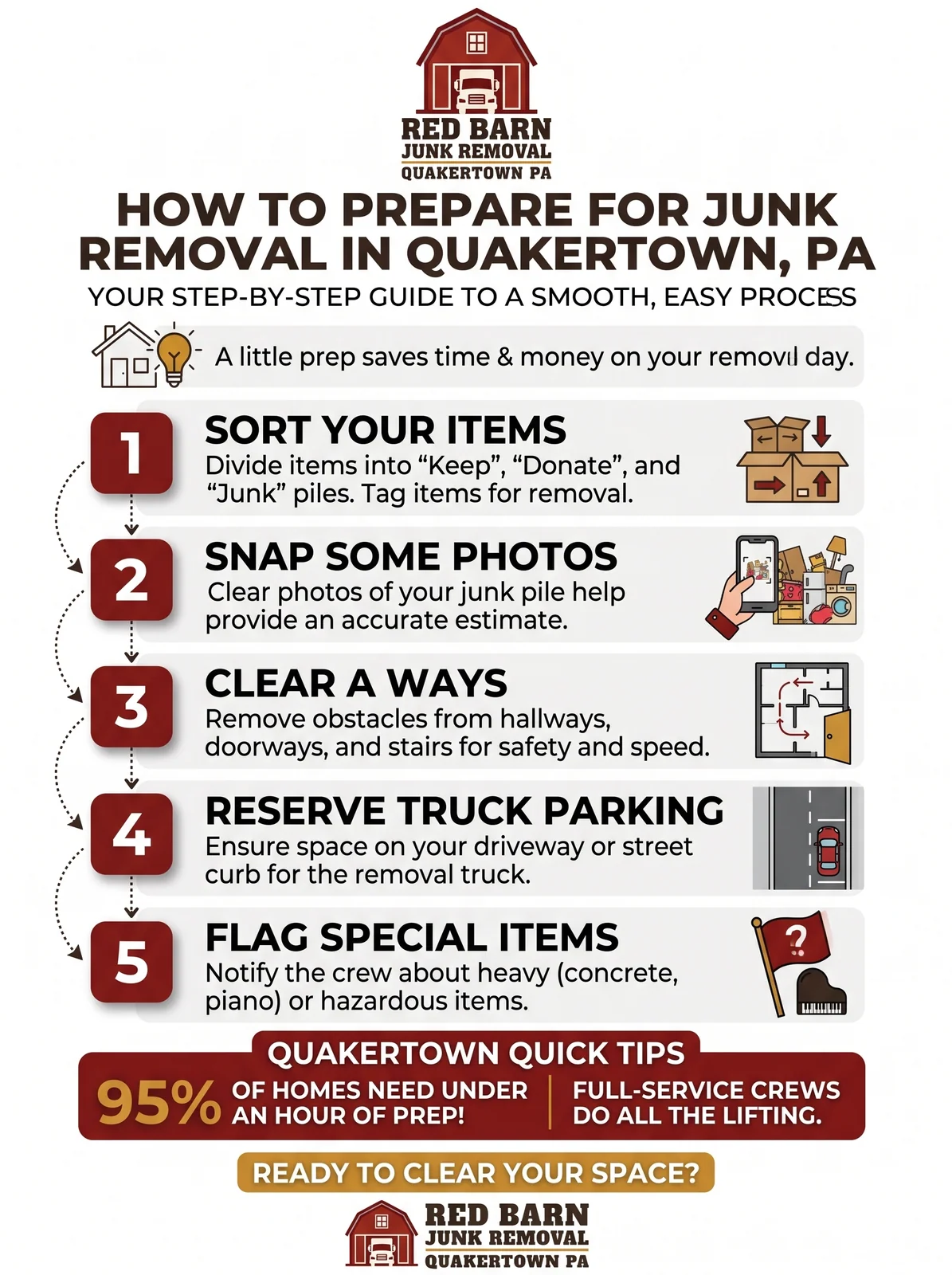
To prepare for junk removal, decide what’s going and what’s staying, take a few clear photos so your estimate is accurate, clear a path to the items along with a parking spot for the truck, and confirm your appointment window. Most homes need under an hour of prep, since a full-service crew handles the actual lifting. This guide walks through each step, plus what’s specific to Upper Bucks properties — barns, stone farmhouses, and Quakertown’s borough row homes.
What to know before the crew arrives:
Sorting keep-vs-go items ahead of time keeps the estimate accurate.
Photos of the pile, the access path, and anything heavy speed up quoting.
Clearing walkways and reserving truck parking matters more than moving items yourself.
Certain items — concrete, oil tanks, electronics — need to be flagged before the crew shows up.
Some materials, like old TVs and liquid oils, can’t legally go with a standard hauling load.
A Quick Prep Checklist Before the Crew Arrives
Here’s the short version. The sections below explain each of these in more detail, but if you only have five minutes, this covers it:
Sort items into “go” and “stay” piles, or tag what needs to leave.
Take a few photos of the pile and the path to it, for an accurate estimate.
Clear walkways — hallways, stairs, doorways — of anything blocking the route.
Reserve a parking spot for the truck, whether that’s a driveway or a stretch of curb.
Flag anything heavy, hazardous, or unusual: concrete, an oil tank, a piano, old electronics.
Confirm your appointment window the day before, and know how you’ll pay.
With Red Barn Junk Removal of Quakertown, the crew does every bit of the carrying — out of the basement, the attic, the garage, or the barn loft. Your job is to make the decisions and clear the way, not to haul anything yourself.
Step 1: Decide What Goes and What Stays
Sorting ahead of time is what makes an estimate accurate and keeps nothing wanted from getting hauled off by mistake. Walk through the space and separate items into two groups: what’s leaving, and what’s staying put.
You don’t need to drag anything to the curb — that’s the point of full-service removal. But a clear tag, sticky note, or physical separation prevents confusion on the day. If a piece of furniture is going but a similar one nearby is staying, mark it. If there’s a box of items you’re still deciding on, set it in its own corner so the crew knows to leave it alone.
This step also gives you a chance to pull aside anything donation-worthy before it goes in the truck, if that matters to you. A little sorting up front saves a conversation later.
Step 2: Take Photos for an Accurate Estimate
Good photos are the difference between a rough guess and a solid estimate range. A single blurry shot of a pile tells an estimator almost nothing about volume or access — and volume is what determines the price.
Five photos cover what’s needed:
The whole pile or room, shot wide from the doorway.
A second angle showing depth — a pile photographed straight-on hides how much is actually there.
Close-ups of anything heavy or unusual: an appliance, a piano, an oil tank, a stack of concrete or brick.
The access path — stairs, doorway width, driveway, and how far a truck would need to carry things.
Something in frame for scale, like a doorway, a person, or a standard trash can.
With those five shots, an estimator can give you a real range — say, a half-load to a three-quarter load — instead of a guess. The crew still confirms the exact price at your property before anything is loaded, but a good photo set means that number rarely moves much from what you were quoted.
What Details to Mention When You Book
A few extra details help the estimate land right the first time:
What’s the single heaviest item in the load?
Is anything located below ground level, or above the first floor?
Is there any concrete, brick, dirt, or soil mixed in?
Any oil tank, Freon appliance, TV, or monitor involved?
Can a truck park within roughly 50 feet of the pile?
Answering these on the phone or in a form takes a minute and avoids surprises once the crew arrives.
Step 3: Clear a Path and a Spot to Park the Truck
Access is the hidden variable in junk removal — more than volume, it’s what actually determines how long a job takes. Clear hallways and doorways of anything blocking the route, unlock any gates, move parked vehicles out of the way, and reserve a spot — driveway or street — where the truck can sit close to the property.
This looks different depending on where you live. In Quakertown’s borough grid near Broad and Main, that often means narrow staircases, rear-alley access, and on-street parking to plan around — worth mentioning when you book so the crew knows what to expect. On rural Upper Bucks properties, the bigger factor is usually distance: how far the truck can get from the barn, shed, or back field where the items actually sit.
A clear path isn’t just tidiness — it’s what keeps the job on schedule and the price where it was quoted.
Step 4: Separate Items That Need Special Handling
Certain items change how a job is priced or handled, and it helps to flag them before the truck shows up. That includes heavy material like concrete, brick, dirt, and soil; pianos; heating-oil tanks and radiators; appliances that use Freon; and electronics like TVs, monitors, and computers.
None of these are a problem for a full-service crew — a good junk removal outfit takes items many haulers simply refuse. But identifying them ahead of time means the estimate reflects reality, and there’s no back-and-forth once the truck is in the driveway.
Heavy Material and Why It’s Priced Differently
Concrete, brick, dirt, and soil are typically priced with a heavy-material surcharge, and there’s a straightforward reason: landfills and transfer stations charge by weight, not by volume, for this category. A truckload of couches and boxes and a truckload of broken concrete take up the same space but cost very differently to dispose of.
The right way to handle this is disclosure up front, not a surprise on-site. Ask about it when you book, and expect a company to explain the surcharge before the crew ever arrives — not after the truck is loaded.
What You Can’t Put Out for Junk Removal (Quakertown Rules)
Some materials can’t go out with a standard hauling load at all, for legal or practical reasons. Worth knowing before you plan a cleanout:
Asbestos and any asbestos-containing material — this requires specialized abatement, not standard hauling.
Paint, solvents, chemicals, and pesticides — these route to Bucks County household hazardous waste collection events, not curbside trash or a junk truck.
Motor oil and cooking oil — transfer stations refuse liquid oils outright, so these need a separate disposal path.
Propane tanks and other flammables — not accepted for standard removal.
Medical or biohazard waste — requires certified disposal channels.
There’s also a legal wrinkle worth knowing: since 2013, Pennsylvania trash haulers have not been permitted to accept TVs, computers, or monitors as part of regular trash, under the Covered Device Recycling Act (Act 108 of 2010). These items need certified electronics recycling instead. Quakertown Borough also publishes its own list of items its waste management department won’t collect curbside — worth a check before assuming something can just go to the curb. A junk removal company can take these items for you and route them to the right place, which is often the simplest option for a homeowner who doesn’t want to track down separate disposal for each category.
Confirming Your Appointment and Payment
Crews generally work daytime windows, and most companies give you an arrival window rather than an exact time — traffic, prior jobs, and transfer station hours all affect the schedule. Confirming your appointment the day before, if a company reaches out, helps avoid a missed slot or a rescheduled truck.
Many companies now take a card to hold your slot without charging anything until the job is actually complete, paired with a free cancellation window if your plans change. It’s worth reading the booking terms before you commit, so you know exactly what happens if you need to reschedule.
Payment itself is usually collected once the job is done — commonly by card, Venmo, or CashApp — rather than up front. That way you’re only paying for the work once it’s actually finished and you’ve seen the result.
Preparing Specific Types of Jobs
Prep looks a little different depending on the size and type of job. Here’s what changes for the bigger or more specialized cleanouts common in Upper Bucks.
Whole-House, Estate and Hoarding Cleanouts
Larger cleanouts — full estates, whole-house jobs, hoarding situations — usually mean multiple truckloads rather than one. Plan for more time, and go room by room deciding what stays versus what goes, rather than trying to sort the whole property at once. Retrieve important documents, valuables, and anything sentimental first, before the sorting gets underway, so nothing important ends up mixed in with items headed for the truck. A company running multiple trucks can often clear a large property in fewer visits, which matters when a property needs to be ready for a sale or an estate settlement on a deadline. If you’re coordinating one of these, our estate cleanout services page covers how a multi-load property typically gets scheduled.
Barn, Outbuilding and Farm Cleanouts
Rural Upper Bucks properties come with their own prep list. Before a crew arrives at a barn or outbuilding, identify anything that’s scrap metal, old farm equipment, or a heating-oil tank — these are common finds in bank barns and oil-heated farmhouses across the area, and they change how a job gets priced and handled. Note if any part of the property is ladder-only access, like a hay loft, since that affects how the crew plans the carry. And flag anything where the material is unclear — old drums, unmarked containers, anything that might not be simple scrap — so it can be assessed before loading rather than during it. Overgrown yards and old fencing on the same property are also worth clearing out in the same visit; our yard waste removal page covers how that typically gets bundled in.
Rental Turnovers and Cleanouts When You’re Not On Site
Landlords, realtors, and out-of-area owners often need a property cleared without being there in person. The prep for this is mostly about instructions: leave clear access details (a lockbox code, gate instructions, where to park), confirm in writing what’s staying versus what’s going so there’s no ambiguity, and ask for photo documentation once the job is done. That documentation matters more here than in an attended cleanout, since it’s your main way of confirming the work without seeing it yourself.
Frequently Asked Questions
How long does it take to prepare for junk removal?
Most homeowners need under an hour: sort keep versus go, take a few photos, clear a walkway, and reserve truck parking. Larger cleanouts — estates, hoarding situations — take more planning. Since a full-service crew does the actual lifting, prep is about access and decisions, not moving items yourself.
Do I need to move items to the curb myself?
No. With full-service junk removal, the crew carries items out of the basement, attic, barn, or back field themselves. Your part is clearing a path and identifying what’s leaving — not hauling anything to the curb.
How is junk removal priced — by weight or by volume?
Most junk removal is priced by volume — the truck space your items fill — rather than by weight. Heavy material like concrete, brick, and dirt often carries a separate surcharge, since landfills charge by weight for that category. A photo estimate gives you a range; the firm price gets confirmed at the property before anything loads.
Can I get an estimate from photos?
Yes. Clear photos — a wide shot, a second angle for depth, close-ups of heavy items, the access path, and something for scale — let a company give you an accurate range before they even arrive. The exact price still gets confirmed on site, but good photos keep that number close to what you were quoted.
Why won’t my trash service take my old TV or computer?
Since 2013, Pennsylvania law has barred trash haulers from accepting TVs, computers, and monitors as regular trash, under the Covered Device Recycling Act. These items need to go through certified electronics recycling instead. A junk removal company can take these off your hands and route them correctly, so you’re not stuck finding a separate drop-off.
What items can’t a junk removal company take?
Standard exclusions include asbestos, paint and household chemicals, pesticides, motor and cooking oil, propane and other flammables, and medical or biohazard waste. These require specialized disposal channels rather than curbside trash or a hauling truck — items like paint and chemicals typically route to a Bucks County household hazardous waste collection event instead.
Should I be home during the junk removal?
Being present helps you confirm exactly what’s going and approve the final price on the spot. That said, many companies also offer lockbox or unattended cleanouts for landlords and out-of-area owners, with clear written instructions beforehand and photo documentation sent once the job wraps up.
If you’re in Quakertown or anywhere across Upper Bucks and want a free, no-obligation estimate, send a few photos or give us a call. Red Barn Junk Removal of Quakertown is based right in Quakertown and on the road across Upper Bucks daily — reach us at (215) 607-8804 and we’ll walk you through the next steps, whether it’s a single room or a whole property.
Not sure a specific hauler is the right fit for your job? It’s worth thinking through what matters most — our guide on choosing a junk removal company covers the questions worth asking before you book anyone. And if you’re weighing a dumpster against a hauling crew for a bigger project, our page on the dumpster rental alternative breaks down when each option makes more sense. For smaller jobs — a couch, a bedroom set, a few pieces you want gone without a full cleanout — our furniture removal service page covers how that typically works. And if you’re just trying to figure out what counts as ordinary junk versus what your local hauler will take, our overview of trash removal Quakertown options is a good place to start. Call (215) 607-8804 when you’re ready to get a firm price for your property.
Red Barn Junk Removal has cleared barns, basements, garages and whole properties across Quakertown and Upper Bucks County since 2015 — over 1,000 completed jobs, 2–3 trucks on the road daily, and a crew of nine to eleven working out of 127 S 5th St. The company takes what most haulers turn down over the phone: concrete, brick and excavated soil, pianos, heating-oil tanks, cast-iron radiators and farm scrap. Every guide on this site comes out of what the crews actually meet on Upper Bucks properties — stone farmhouses with winding cellar stairs, bank barns with ladder-only lofts, and borough row homes with one narrow staircase. Registered Pennsylvania Home Improvement Contractor, PA #PA112494.